
The Sunday Reset: How I Plan a Week of Outfits (Without Losing My Mind or My Style)
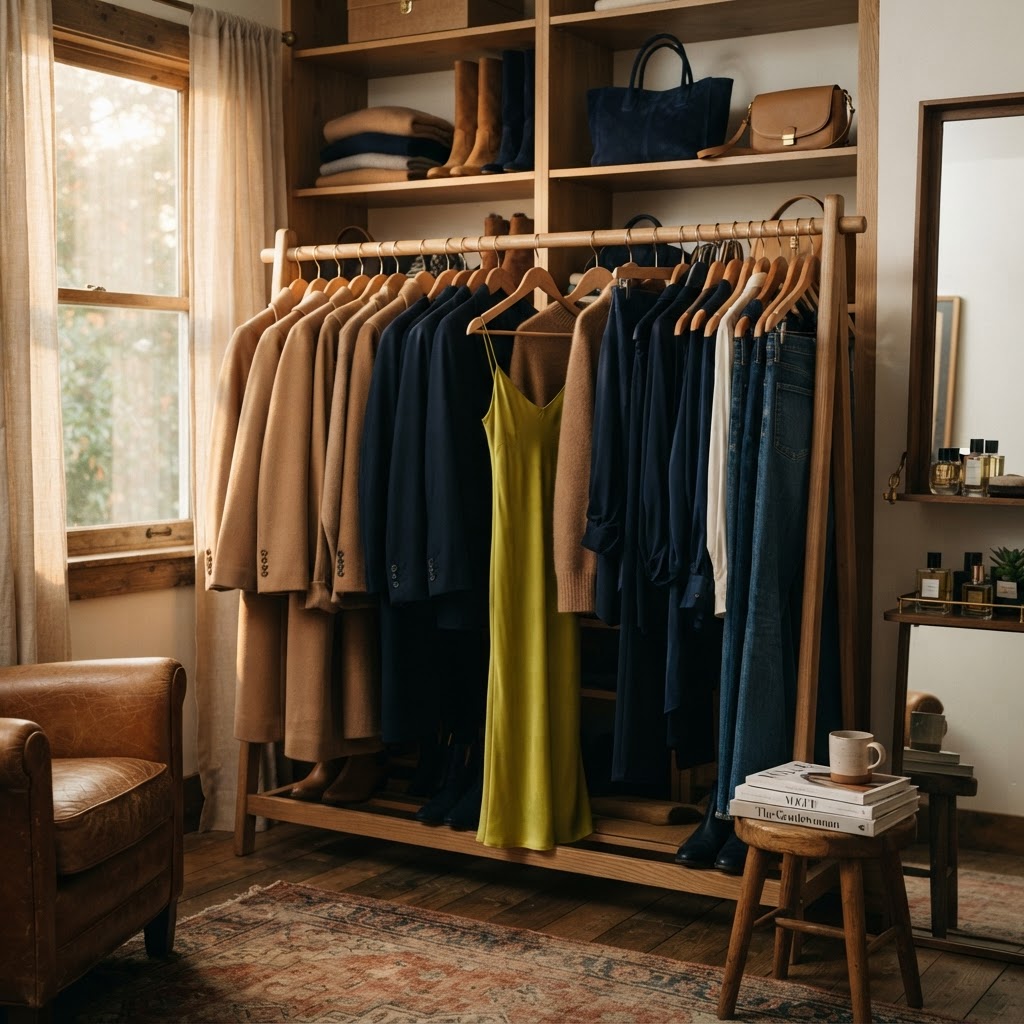
Sunday has one non-negotiable rule in my house: the closet and the room get straightened before anything else happens. It sounds small, but it's the whole game. A cluttered closet doesn't just look messy — it makes decisions harder. When everything is visible and in order, your eye can actually do its job.
If straightening feels like too much on a given Sunday, scale it down. Pull three to five things you no longer wear. Not "someday" pieces — things you already know are dead weight. That's enough to clear a path and make the week's choices easier.
Give Yourself One Outfit That Scares You a Little
Somewhere in the week, I try to build one or two looks that sit just outside my comfort zone — an unexpected color combination I wouldn't reach for on autopilot. Chartreuse, navy, and camel, say. Something that makes me pause before I put it on. This is less about the outfit itself and more about keeping the muscle of experimentation warm. A closet only teaches you something new if you occasionally ask it a new question.
The Case for a Uniform (Sort Of)
Michael Kors wears a black tee and jeans nearly every day because it makes him feel confident, at ease, and free of decision fatigue. Marc Jacobs is the opposite — a full fashion plate, every day an event. I think the best version of a personal style lives somewhere between the two.
My own partial uniform for fall and winter starts with a black sweater — cashmere, lambswool, or merino. The neckline, thickness, silhouette, and sleeve length shift, but I've accepted that I rarely reach for anything else on top. What keeps it from feeling static is what I build around it: a red boot, an unexpected trouser color, a blouse peeking out underneath.
The other constant is a black boot — Chelsea, knee-high, or an UGG, depending on the day. Whatever else comes into the look, I balance it with a pop of color or a statement jacket. I generally avoid all-denim, brown with black, or navy with black — though "generally" leaves room for the days I break my own rule on purpose.
Let the Week Reveal What's Missing
Something useful happens when you lay out a full week of looks side by side: you start to see the gaps. Right now, I know I'm missing a blue boot — a real one, not a substitute. Laying out combinations either confirms I need to invest in that piece, or reveals a neutral I already own that could stand in and look just as good.
Either way, the outfit-planning exercise becomes a quiet form of closet auditing. It tells you what to buy, and just as often, it tells you what you don't need to.
The Real Goal Is Editing, Not Adding
The better use of this whole process isn't building a shopping list — it's figuring out what to let go of. And it's completely fine to repeat pieces across the week in different combinations. Wearing the same sweater three times with three different pairings isn't a rut; it primes creativity. Constraint is often what makes styling more inventive, not less.
This is a process you can do with support at first — pulling everything out, talking through combinations — and there's a good chance that within a few weeks, you'll start editing on instinct alone.
Photograph the Looks
I photograph each outfit as I finalize it, building a running lookbook for myself. This isn't about locking in a set rotation — it's a reference. When I'm getting dressed on a rushed morning, I can glance at a photo and swap out one piece rather than starting from zero. The picture holds the idea of the outfit loosely enough that it still leaves room to improvise.
Dressing for Work That Moves: The Massage Therapist Version
My work adds its own set of rules. As a massage therapist, what I wear has to be comfortable without sliding into sloppy, cute without tipping into sexy, fine with getting a little oil on it, and layered — because the work runs warm. Some of it happens barefoot, so shoes need to come off easily.
My clients have come to expect a good graphic tee — band tour shirts, mostly, always vetted for no politics, no alcohol branding, nothing sexy or vulgar — paired with a stretchy jean I can roll up, or a button-down or nicer flannel over it. A longer cardigan, a cool belt that doesn't get in the way of the work, shoes I can slip off without a fuss.
Most of my colleagues lean sporty — leggings and slides. I did too, for a while, out of pure convenience. But it wasn't really me, so I adapted the easy version to fit my actual style instead of abandoning style altogether for comfort's sake.
I also plan for the in-between hours. Realistically, changing clothes twice a day isn't always going to happen — there's a dog walk, an errand, a happy hour with a friend, all still in work clothes. So the goal is to dress in a way that holds up outside the massage room too, whether or not an actual outfit change happens. Know your own pattern here — some people change multiple times a day happily, others would rather not — and build the week's plan around whichever is true for you, so you feel confident moving between settings either way.
Know Your Shapes, Not Just Your Colors
One thing this process taught me: I love the look of a smart, tailored blazer, and I own a few. But my instinct, over and over, runs toward softer shapes — cardigans, unstructured shirts, and always, always the sweater. Planning a full week makes patterns like this impossible to ignore. It's less about picking outfits and more about finally noticing what you actually reach for, versus what you think you should.
Pick Your Bag for the Week, Not the Day
If swapping bags daily genuinely isn't a hassle for you — some people love the ritual of it — skip this part and let each look dictate its own bag. But for most of us, switching bags every day is a hassle in more ways than one: the re-packing, the misplaced lip balm, the transferred keys you forget until you're at the door. So instead, choose one bag for the whole week and find the through line in your looks that lets it work across all of them.
This is really the same exercise as the outfits themselves, just in reverse. Instead of building looks and then finding a bag to match, pick the most wearable, most versatile bag you own and plan the week's color and texture choices so it moves seamlessly between them. It's one less decision every morning, and it usually pushes you toward the bag that's actually earning its keep in your closet — versus the one that only works with a single outfit and mostly just sits on a shelf.
Save Yourself the Pre-Event Meltdown
This system pays off hardest on the nights that matter — a date, a gallery opening, a bachelorette, a concert. Think about every time you've run late to something because nothing looked right and you were assembling and reassembling the same outfit an hour before you needed to walk out the door. That specific flavor of chaos — sweating, swearing, occasionally sobbing, depending on the stakes — is almost entirely preventable.
If you have even a loose sense of what's coming up that week, work through the outfit for the higher-stakes event during your planning session, well before you actually need it. And yes, "Sunday" is really shorthand here — pick whatever day genuinely functions as your planning day. Not everyone runs on a standard schedule. If weekends are your busiest stretch for work or travel, Wednesday might be your real Sunday. The point isn't the specific day; it's having one.
This also doesn't need to lock you in. Planning it out doesn't mean you can't change your mind as the week goes on — that's completely normal. But having already worked through the decision once means the day-of version is a quick edit instead of a full crisis. It's also worth noting: how often do we end up circling back to the very first outfit we picked anyway? Working it out in advance just gets you there with your nervous system intact.
It's also worth deciding how many days you're actually planning for. A full seven-day layout works if your schedule holds steady. But if your week is more fluid or unpredictable by necessity, planning three or four days at a time and revisiting mid-week can serve you better than committing to a rigid week you'll inevitably have to unwind.
The Point of All This
A weekly outfit setup does more than solve "what do I wear." It surfaces your real style — not the aspirational one, the lived-in one. It shows you what's working in your closet and what's just taking up space. It keeps creativity active instead of dormant. And it's genuinely one of the better tools for getting to know your own taste.
Check the weather before you commit to anything. And give yourself full permission to modify as the week goes — because a plan that can't flex with weather, mood, or whim isn't really a style system. It's just another rule to break.
Curate beautifully. Consume consciously.